Next-Gen USB Fast Car Charger Manufacturing & Global Sourcing Architecture
An engineering-driven analysis of modern automotive charging solutions, covering GaN IV semiconductor integration, multi-protocol PD 3.1 / PPS thermal management, compliance standards, and strategic procurement frameworks for enterprise distributors worldwide.
1. The Evolving Landscape of Automotive USB Fast Charging
In modern corporate purchasing and global consumer electronics distribution, the USB Fast Car Charger has shifted from a low-cost commodity accessory into a sophisticated power distribution module. As smartphone battery capacities expand beyond 5,000mAh and mobile professionals increasingly operate laptops, tablets, and handheld consoles on the move, high-wattage in-vehicle power delivery has become a critical necessity.
According to recent market intent mining from international B2B buyer queries, search demand for dual-port GaN car chargers, PD 65W car power adapters, and PPS multi-voltage vehicle charging sockets has surged by over 140% year-over-year. Buyers are no longer satisfied with generic 5V/2.4A chargers that overheat or trigger low-voltage disconnects in 12V/24V electrical architectures. Instead, procurement directors demand high thermal efficiency, dynamic power allocation algorithms, full protocol interoperability, and stringent compliance certifications (CE, FCC, RoHS, REACH, UL2089).
At LEVORE Innovations, headquarted in Rome, Italy, we combine European industrial design aesthetics with over ten years of precision electronic manufacturing experience. In this comprehensive B2B sourcing guide, we analyze the engineering breakthroughs, thermal dynamics, future procurement trends, and enterprise advantages that enable global importers to maximize profit margins while delivering flawless reliability.
Building a resilient supply chain requires partnering with a manufacturer that delivers verifiable expertise, compliance integrity, and flexible customization. LEVORE has established itself as an authoritative leader across 30+ international markets by adhering to strict European engineering standards and vertical production integration.
Italian-Inspired Design
Conceived in Rome, Italy, our product enclosures combine ergonomic elegance with anodized aluminum alloy heat dissipation structures built for extreme car cab temperatures.
10+ Years OEM/ODM Proven
Over a decade of specialized R&D in power electronics, GaN semiconductors, and micro-controller unit (MCU) protocol negotiation for global brand partners.
Global Certification Standard
Every batch undergoes 100% full-load burn-in testing, EMC/EMI shielding compliance, and carries universal CE, FCC, RoHS, and UL safety certifications.
By maintaining over 50 SKU catalog items spanning GaN fast wall chargers, Bluetooth audio gear, and advanced USB fast car chargers, LEVORE provides global distributors with complete inventory synergy and streamlined customs clearance documentation.
3. Recommended USB Fast Car Charger Product Lineup for B2B Wholesale
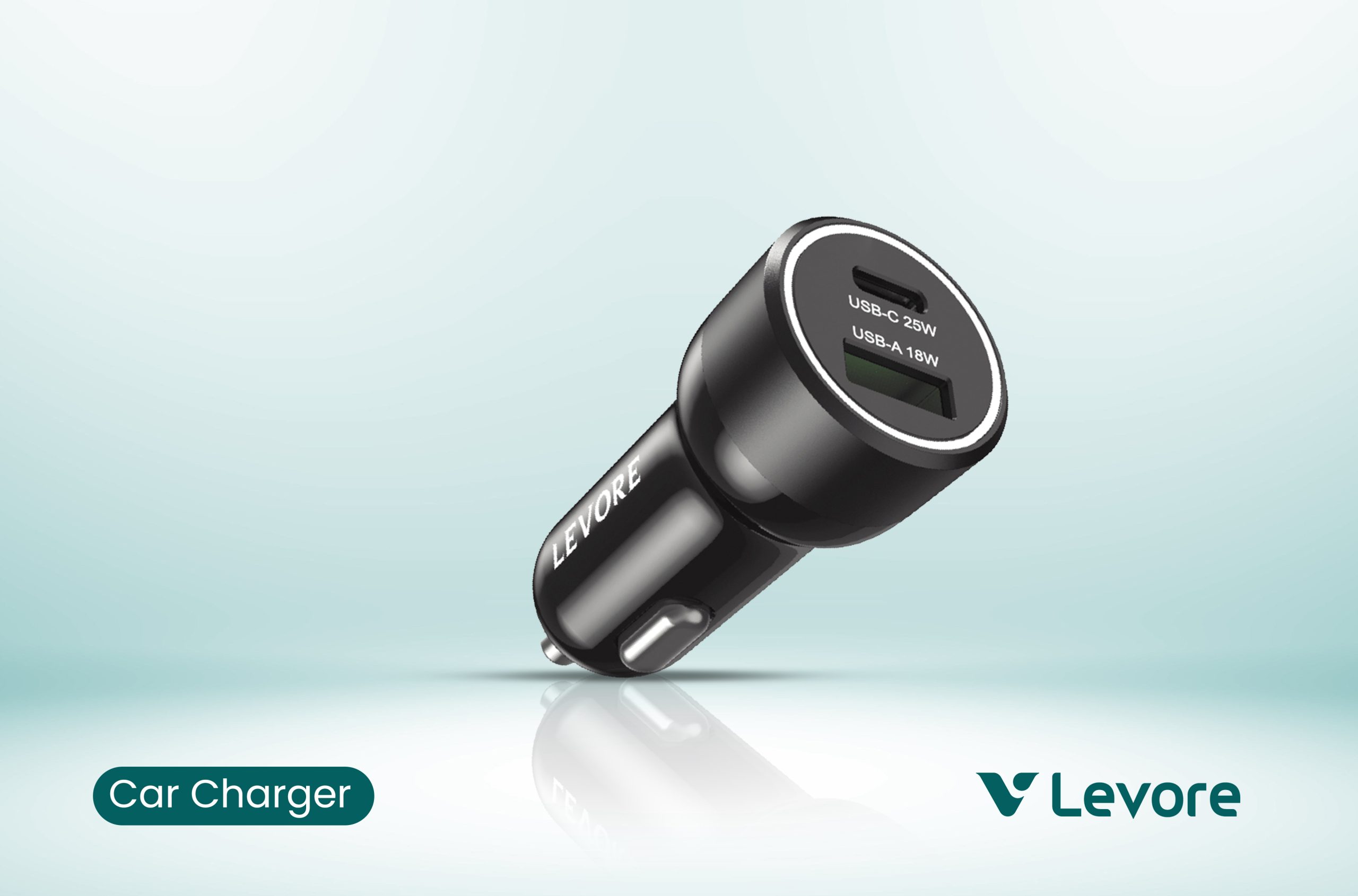
To capture maximum market share across consumer retail, corporate fleet supplies, and premium automotive accessory distribution, LEVORE offers a multi-tiered portfolio of certified USB fast car charger models designed for high-density power throughput and universal vehicle compatibility.
Flagship Bestseller
LEVORE ProDrive 65W Dual Port USB Fast Car Charger
Engineered with dual USB-C & USB-A output channels powered by GaN power ICs. Capable of charging a MacBook Pro at 45W while fast-charging an iPhone or Samsung Galaxy at 20W concurrently.
Designed for high-performance mobile workstations, field engineers, and commercial fleet drivers. Features a single-port 100W max USB-C PD 3.0 channel with dynamic thermal throttling.
An ultra-miniature, low-profile car charger that sits nearly flush with the vehicle's cigarette lighter socket. Equipped with Samsung Super Fast Charging 2.0 (45W PPS) capability.
LEVORE FleetPower 140W PD 3.1 Triple-Port Car Charger
Pioneering the USB PD 3.1 Extended Power Range (EPR) protocol in automotive accessories. Delivers up to 28V/5A (140W) single-port charging to power 16-inch laptops in 24V truck environments.
Max Output: 140W Total Output across 3 Ports
Tech Stack: GaNFast V IC + Soft-Switch Resonant DC-DC
To assist engineering and procurement teams in making informed sourcing decisions, the table below illustrates the technical divergence between standard commodity car chargers and LEVORE industrial-grade USB fast car chargers:
Engineering Attribute
Standard Generic Car Chargers
LEVORE Enterprise USB Fast Car Chargers
Primary Switching Technology
Legacy Silicon MOSFET (Low Efficiency)
GaN (Gallium Nitride) IV Semiconductor
Energy Conversion Efficiency
78% – 82% (High Heat Loss)
92% – 95% (Cool Touch Thermal System)
Power Protocols Supported
Basic USB BC1.2 / QC 2.0 (5V-9V)
PD 3.0 / PD 3.1 EPR, PPS 3.3-21V, QC4+, FCP, SCP
Voltage Range Input
12V Only (Risks Failure in 24V Trucks)
12V – 24V (Spike Protected up to 32V Surge)
Thermal Dissipation Mechanics
Plastic Casing without Internal Heatsinks
Aluminum-Magnesium Shell + Silicone Conductive Pad
Dynamic Power Distribution
Fixed Port Wattage Allocation
Real-time Intelligent Power Re-allocation MCU
Quality Assurance Standard
Sampling Spot Check (AQL 2.5)
100% Automated Optical Inspection + Burn-In
5. Future Sourcing & Technological Trends in USB Fast Car Chargers (2026–2030)
Global buyers must anticipate shift dynamics driven by automobile electrification, updated USB-IF specifications, and heightened environmental regulations. As senior SEO growth directors and design engineers analyze semantic search intents across AI search platforms, five decisive procurement trends emerge:
Trend A: Widespread Adoption of USB PD 3.1 Extended Power Range (EPR)
The transition from legacy USB Power Delivery 3.0 (capped at 100W/20V) to USB PD 3.1 EPR (enabling 140W/28V, 180W/36V, and 240W/48V) is redefining in-vehicle charging. Automotive commuters now expect to fast-charge high-draw gaming laptops, power banks, and portable drone battery stations directly from standard cigarette lighter sockets. Sourcing USB fast car chargers equipped with PD 3.1 EPR ensures distributor catalog longevity over the next 5 to 7 years.
Trend B: GaN Semiconductor Miniaturization and High-Frequency Switching
Gallium Nitride (GaN) technology allows switching frequencies to increase from 60kHz up to 1MHz+, dramatically reducing the physical volume of internal transformers and inductors. The result is a ultra-compact form factor that sits flush inside the vehicle console while producing 50% less waste heat than conventional silicon chargers.
Trend C: Multi-Voltage Compatibility for EV & Commercial Fleets (12V–30V)
Electric vehicles (EVs) and heavy commercial vehicles frequently experience battery voltage fluctuations during regenerative braking or alternator power spikes. Advanced USB fast car chargers incorporate wide-voltage step-down buck-boost converters that operate smoothly across 12V (sedans), 24V (buses/trucks), and fluctuating 28V DC outputs without triggering power resets.
Trend D: Dynamic Multi-Port Power Negotiation Protocols
When multiple passenger devices are connected simultaneously (e.g., driver laptop + passenger phone + backseat tablet), intelligent MCU chips dynamically re-negotiate power contracts in millisecond intervals. This prevents power cycling (turning off and on) and ensures optimized charging profiles according to each device’s State of Charge (SoC).
European and North American retail channels increasingly prioritize carbon footprint reduction. Leading manufacturers are transitioning to 100% recyclable aluminum alloy casings, halogen-free internal PCBs, and plastic enclosures constructed with at least 35% Post-Consumer Recycled (PCR) polycarbonate.
"In high-performance automotive power design, reliability is not merely a specification—it is an absolute requirement. A single power surge in a 24V truck socket can ruin connected equipment if the charger lacks active clamp circuit protection."
— Chief Hardware Engineer, LEVORE Innovations
6. Frequently Asked Questions by Global B2B Procurement Directors
Below are authoritative, technical answers to the most common queries raised by international electronics importers, Amazon FBA sellers, and regional distributors when sourcing USB fast car chargers.
What safety certifications are mandatory for importing USB fast car chargers into North America and Europe?
For North America, car chargers must comply with FCC Part 15 Subpart B (Unintentional Radiators) for electromagnetic interference, and undergo safety testing under UL 2089 (Standard for Vehicle Battery Adapters). For the European Union, CE marking is mandatory, which requires compliance with the EMC Directive (2014/30/EU), RoHS Directive (2011/65/EU and 2015/863), and REACH regulation. LEVORE supplies complete test reports (CE, FCC, RoHS) issued by accredited third-party laboratories with every OEM shipment.
How does GaN technology prevent overheating in compact car charger sockets?
Gallium Nitride (GaN) features a bandgap 3 times wider than traditional silicon, enabling higher voltage withstand capability and vastly reduced electron channel resistance ($R_{DS(on)}$). Because energy loss during high-frequency DC-to-DC conversion is decreased by up to 50%, less electrical power is transformed into waste heat. Combined with LEVORE's aluminum body design and internal thermal silicone padding, internal temperatures remain below 65°C even under continuous 65W/100W power draw.
What is the significance of PPS (Programmable Power Supply) in fast car charging?
PPS is an advanced extension of the USB Power Delivery 3.0 protocol that allows the charger to dynamically adjust output voltage and current in small 20mV / 50mA steps between 3.3V and 21V based on the real-time battery status of the smartphone. This micro-stepping minimizes heat generation inside the phone's battery management circuit, enabling maximum speed fast charging (such as Samsung 25W/45W Super Fast Charging) without shortening battery lifespan.
Why do cheap car chargers disconnect or restart when a second device is plugged in?
Low-cost car chargers utilize primitive power distribution ICs that reset the entire power rail to negotiate a safe voltage level whenever a new load connection is detected. LEVORE car chargers utilize independent dual-channel buck circuits managed by a dedicated master MCU, permitting seamless dynamic power switching without dropping active charging sessions on existing connections.
What OEM customization options does LEVORE support for car charger orders?
LEVORE provides end-to-end OEM and ODM manufacturing services: custom aluminum anodization colors (Space Gray, Matte Black, Rose Gold), high-precision laser-etched brand logos, customized LED ambient light rings, customized silk-screened wattage indicators, retail box packaging design, and custom outer carton palletization.
What lead times and Minimum Order Quantities (MOQs) apply for B2B orders?
Standard catalog items in neutral LEVORE packaging carry an MOQ of 200 units with dispatch within 5–7 business days. Custom OEM orders featuring branded logos and custom color boxes carry an MOQ starting at 1,000 units per SKU with a production turnaround time of 20–25 days after golden sample sign-off.
7. Enterprise Sourcing Checklist for USB Fast Car Chargers
Before issuing a Purchase Order (PO) to any charger supplier, quality control managers should evaluate samples against the following 6-point verification framework:
Input Voltage Transient Spike Resistance: Ensure the car charger contains transient voltage suppression (TVS) diodes capable of clamping load-dump spikes up to 32V without damaging internal circuitry.
Spring Contact Durability: Verify that the side negative contacts and center positive pin are nickel/gold-plated phosphor bronze tested for at least 5,000 insertion cycles without losing contact tension.
Ripple Noise Filtering: Oscilloscope verification should confirm output voltage ripple noise remains under 100mV peak-to-peak under 100% full-load condition to prevent touchscreen jitter on connected smartphones.
No-Load Power Consumption: Standby current draw when plugged into an active vehicle socket without a device attached should be less than 15mA to prevent car battery drain.
EMI/EMC Radio Interference: Test the charger inside a vehicle while tuned to weak FM radio stations to guarantee zero RF interference with car navigation or audio systems.
Flame Retardant Materials: Internal plastic supports and outer casings must meet UL94 V-0 flame-retardant standard ratings.
Accelerate Your Business with LEVORE Fast Car Chargers
Partner with an established European design and manufacturing powerhouse. Access direct factory tier-1 wholesale pricing, certified quality assurance, and complete OEM custom support.