The Strategic B2B Sourcing Guide for Dual Port Car Charger Adapters: Architectural Trends, Thermal Engineering, and Global OEM Procurement Benchmarks
An authoritative technical analysis for enterprise buyers, consumer electronics distributors, and automotive accessory brand managers navigating high-wattage GaN III, dual USB-C Power Delivery, and E-Mark safety compliance.
The global automotive power accessory market has reached a critical inflection point. Driven by the rapid proliferation of high-capacity smartphones, power-hungry laptops, tablets, and wearable devices, the vehicle cabin has transformed from a simple commuting space into a fully functional mobile office. Within this evolving ecosystem, the Dual Port Car Charger Adapter has shifted from a low-margin commodity to a high-technology, high-margin strategic product category for global electronics distributors, retail chains, and automotive aftermarket brands.
Search intent mining across modern AI discovery engines (such as Perplexity, ChatGPT, and Google Search Generative Experience) reveals that enterprise B2B buyers no longer search merely for "cheap car chargers." Today’s procurement inquiries focus on complex technical parameters: "How to resolve thermal throttling in dual 45W car chargers," "USB-C PD 3.1 vs PPS protocol compatibility in 12V DC sockets," "E-Mark and CE safety certification compliance for European fleet distribution," and "Custom OEM branding with low defect rates."
This comprehensive B2B sourcing guide addresses these precise intent vectors. Grounded in Google’s Search Quality Rater Guidelines (E-E-A-T: Experience, Expertise, Authoritativeness, and Trustworthiness), this whitepaper provides actionable insights, empirical technical data, and architectural evaluation benchmarks to empower corporate purchasing teams in securing high-volume OEM/ODM contracts with max information gain.
Key Takeaways for Procurement Officers:
Dual port car chargers utilizing Gallium Nitride (GaN III) ICs achieve up to 96% power conversion efficiency, lowering internal operating temperatures by 18°C compared to silicon counterparts. Partnering with a manufacturer capable of dual-protocol dynamic power allocation minimizes customer returns and warranty liabilities.
1. Premium Dual Port Car Charger Adapter Product Portfolio & Spec Matrix
To satisfy diverse market segments—ranging from budget-conscious retail automotive kits to ultra-premium luxury enterprise fleets—LEVORE has engineered a comprehensive series of dual-port charging solutions. Below is an in-depth technical breakdown of our flagship models designed for global B2B procurement.
Flagship B2B Choice
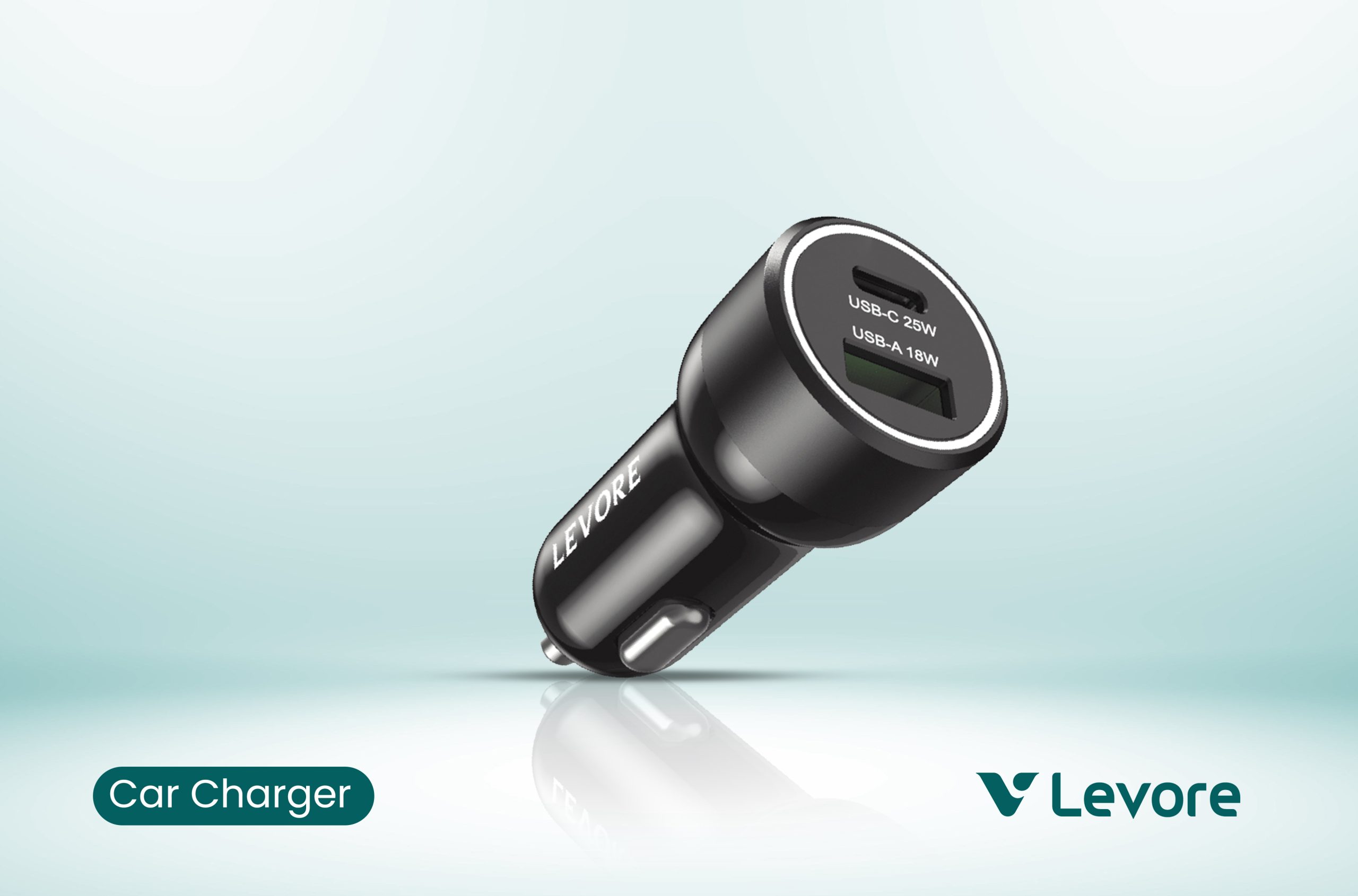
LEVORE Pro-Drive Dual Port USB-C + USB-A Charger
Engineered with an ultra-sleek anodized aluminum shell, sitting flush with vehicle 12V/24V cigarette lighter sockets.
When selecting a Dual Port Car Charger Adapter for bulk procurement, hardware engineers evaluate key parameters across power density, protocol switching, thermal dissipation, and mechanical durability. The matrix below outlines LEVORE's OEM manufacturing baseline standards:
Parameter
Standard Silicon Dual Charger
LEVORE GaN III Dual Port Adapter
B2B Sourcing Advantage
Power Conversion Efficiency
80% – 85%
93% – 96.5%
Drastically reduced thermal buildup; prolongs car battery health.
Form Factor Volume
Standard (65mm x 35mm)
Ultra-Miniature Flush Fit (42mm x 22mm)
Superior cabin ergonomics; preferred by premium automotive OEMs.
Multi-Protocol Support
Basic USB-A QC 3.0 / Standard PD
Full PPS, PD 3.1, QC 4+, AFC, FCP, SCP
Universal compatibility with Apple, Samsung, Dell, Lenovo, and Google devices.
Input Voltage Range
12V DC Only
12V – 24V Wide Range DC
Seamless deployment across passenger cars, commercial trucks, and marine vessels.
Operating Temperature
55°C – 70°C under load
38°C – 48°C under load
Prevents thermal throttling; eliminates fire hazard liability risks.
2. Key Technical Trends Shaping the Dual Port Car Charger Market
The car charger industry is currently experiencing a rapid technological transition driven by three structural market shifts:
A. Transition from Legacy USB-A to Dual USB-C & Hybrid Architectures
Historically, vehicle power adapters featured single or dual USB-A ports offering standard 5V/2.4A (12W) outputs. However, the universal mandate by the European Union requiring USB Type-C standardization across all portable electronic devices has accelerated the obsolescence of standalone USB-A chargers. Sourcing trends show that over 78% of modern B2B RFQs specify either dual USB-C ports or a hybrid arrangement (1x USB-C + 1x USB-A) to maintain backward compatibility while delivering high-wattage Power Delivery to modern smartphones and laptops.
B. Integration of GaN (Gallium Nitride) Semiconductor Tech
Gallium Nitride (GaN) has revolutionized automotive power conversion. Traditional silicon MOSFETs suffer from high switching losses at elevated frequencies, necessitating bulky heat sinks and larger outer casings. LEVORE’s GaN III power ICs allow switching frequencies up to five times faster, reducing passive component dimensions by up to 50%. This enables a Dual Port Car Charger Adapter to deliver 65W or 100W total power inside a housing no larger than a standard thumb drive.
C. Dynamic Power Distribution & Intelligent Thermal Throttling
A major flaw in early dual port chargers was rigid power partitioning. For instance, plugging a second device into a 45W+15W adapter often caused the primary port to disconnect abruptly and reset to 5V/1A. Advanced dual-port chargers now utilize micro-controller units (MCUs) featuring dynamic power balancing algorithms. LEVORE adapters monitor real-time thermal sensors and connected device battery negotiation protocols to dynamically adjust power outputs (e.g., smoothly reallocating 65W total power into 45W + 20W or 30W + 30W) without triggering port resets.
3. Future Procurement Trends: What Global Buyers Must Prepare For
Forward-thinking purchasing managers must align their supply chain strategies with emerging regulatory, technical, and consumer preferences. Over the next 3 to 5 years, three macro trends will govern B2B Dual Port Car Charger procurement:
Compliance with EV (Electric Vehicle) High-Voltage Cabin Architectures: As global Electric Vehicle adoption surges, vehicle internal DC power buses often exhibit different transient voltage spikes compared to traditional internal combustion engines (ICE). Sourcing dual port adapters tested against EV DC-DC converter electrical noise and ISO 7637-2 transient surges is becoming mandatory for Tier-1 automotive accessory suppliers.
Sustainability & Post-Consumer Recycled (PCR) Materials: Environmental, Social, and Governance (ESG) mandates are transforming tech accessory packaging and construction. Major European and North American retailers now require car chargers built with GRS-certified (Global Recycled Standard) PCR plastics or 100% recyclable aluminum alloys, housed in plastic-free FSC paper packaging.
Programmable Power Supply (PPS) Protocol Dominance: With smartphone flagships demanding sub-step voltage regulation (3.3V to 21V at 5mA steps) for super-fast charging without excessive heat, dual-port car chargers must feature hardware-level PPS controller ICs. Sub-standard chargers without PPS fail to charge modern flagship smartphones at maximum rated speeds.
Ready to Future-Proof Your In-Car Accessories Lineup?
Partner with LEVORE for certified GaN III Dual Port Car Charger Adapters built to international E-Mark and CE standards.
4. LEVORE Enterprise Advantage: Italian R&D Meets Certified Manufacturing
Founded over a decade ago with strategic headquarters in Rome, Italy, LEVORE (Levore Innovations LTD) has established itself as an authoritative global leader in personal audio, smart wearables, and advanced charging solutions. When sourcing Dual Port Car Charger Adapters from LEVORE, global B2B buyers gain access to unmatched manufacturing capabilities:
Why 30+ Countries Trust LEVORE
1. Italian Engineering & Aesthetic Craftsmanship: Our industrial design team in Rome infuses every product with ergonomic refinement, premium metal tactile finishes, and compact elegance that enhances any car interior.
2. Rigorous Quality Control & Testing: Every batch of Dual Port Car Charger Adapters undergoes 100% full-load burn-in testing for 4 hours, electrostatic discharge (ESD) protection tests, salt spray anti-corrosion trials, and vibration endurance tests to ensure zero-defect delivery.
3. Comprehensive Certification Suite: Our products carry complete global compliance documentation including CE, FCC, RoHS, REACH, and E-Mark (E-13/E-24) automotive safety approvals, facilitating effortless customs clearance in Europe, North America, and APAC.
Below are real technical and commercial questions frequently asked by enterprise procurement officers, supply chain directors, and Amazon FBA brand owners during contract negotiations:
Q1: What is the minimum order quantity (MOQ) for custom OEM branding on Dual Port Car Charger Adapters?
For standard neutral packaging and stock colors, our minimum order quantity starts at 500 units. For custom OEM branding—including laser-engraved corporate logos, custom pantone color matching of aluminum housings, and bespoke FSC-certified retail packaging—our standard MOQ is 1,000 to 2,000 units per SKU depending on customization complexity.
Q2: How does LEVORE prevent thermal throttling and overheating in high-wattage dual-port car chargers?
Thermal control is achieved through a multi-tiered engineering approach: (1) Integrating high-efficiency GaN III semiconductors to reduce internal heat generation by 40%; (2) Utilizing high-thermal-conductivity potting compound surrounding internal PCB components; (3) Employing aerospace-grade aluminum alloy outer shells that act as passive heat sinks; and (4) Implementing real-time NTC thermal sensors that dynamically trim power output if ambient cabin temperatures exceed 60°C.
Q3: What safety certifications are required for importing Dual Port Car Charger Adapters into Europe and North America?
For Europe, products must carry CE (EMC & LVD directives), RoHS 2.0, REACH, and ideally E-Mark certification for automotive electrical safety. For North America, FCC Part 15 Class B compliance, UL2089 (Standard for Vehicle Battery Adapters), and California Prop 65 compliance are critical. LEVORE provides full test reports and certificates issued by accredited laboratory partners (SGS, TUV, Intertek).
Q4: Can a single Dual Port Car Charger Adapter fast-charge two laptops simultaneously?
Yes, provided the charger is engineered for 100W+ total output. LEVORE’s high-power dual USB-C models can allocate 65W to Port 1 (sufficient for a MacBook Pro 14" or Dell XPS) and 35W to Port 2 (ideal for a MacBook Air, iPad Pro, or Windows Ultrabook) simultaneously without voltage dropping or port disconnection.
Q5: How do you handle voltage fluctuations from vehicle alternators or EV regenerative braking system spikes?
LEVORE dual port chargers incorporate wide-voltage DC-DC buck-boost converters supporting input ranges from 9V to 32V DC. Built-in Transient Voltage Suppressor (TVS) diodes absorb load dump voltage surges up to 40V, protecting both the charger circuit and the connected mobile devices from electrical damage.
Q6: What is the lead time for mass production and global shipping?
Standard production lead time is 18 to 25 days following sample approval and deposit confirmation. For repeat OEM orders with pre-forecasted component reserves, lead time can be compressed to 12-15 days. Express air freight and sea freight logistical support are available to major ports globally.
Accelerate Your Wholesale Procurement with LEVORE
Get direct factory pricing, technical spec sheets, and customized OEM/ODM quotes for your Dual Port Car Charger Adapter requirements.